https://x.com/BASCBALOCH/status/1999890482705645772?s=20
The Baloch Advocacy and Studies Center (BASC) organised an important webinar on Saturday, 13 December 2025, examining the grave and persistent human rights violations faced by the Baloch people in Iran and Pakistan. The webinar brought together leading international experts, researchers, and Baloch human rights advocates to shed light on enforced disappearances, extrajudicial killings, structural discrimination, and the gendered impact of state repression.
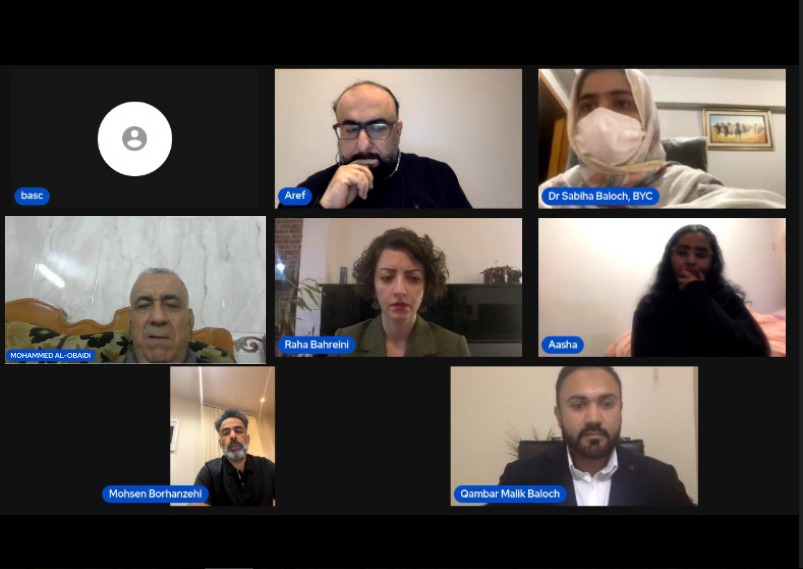
The webinar featured Mr Mohammed Al-Obaidi, member of the UN Working Group on Enforced or Involuntary Disappearances (WGEID); Raha Bahreini, Iran researcher at Amnesty International; Dr Sabiha Baloch, leader of the Baloch Yakjehti Committee (BYC); Abdollah Aref, Lead Researcher on Iran at BASC; Mohsen Burhanzehi, Director of Media and Communications at BASC; and Aisha Baloch, Research Associate at BASC. The discussion was moderated by Qambar Malik Baloch, General Secretary of BASC.
Dr Sabiha Baloch provided a stark overview of the ground realities in Balochistan, Pakistan, highlighting the systematic and multifaceted nature of human rights abuses faced by the Baloch people. She emphasised the widespread practice of enforced disappearances, noting the increasing targeting of Baloch women, alongside extrajudicial killings and the harassment and persecution of human rights defenders and their families.
Aisha Baloch presented key findings from BASC’s recent reports, documenting patterns of state violence, and collective punishment affecting Baloch in Pakistan.
Addressing the issue of enforced disappearances, Mr Mohammed Al-Obaidi strongly condemned the practice, expressed solidarity with victims and their families, and stressed the importance of submitting cases to the UN Working Group on Enforced or Involuntary Disappearances. He noted that the WGEID has repeatedly raised concerns with Pakistani authorities, calling for an end to this draconian practice and urging full compliance with international human rights obligations.
Focusing on Iran, Mohsen Burhanzehi presented a bleak picture of how Baloch women are affected by the state’s systematic policies of marginalisation. He highlighted the severe consequences of structural discrimination, including the large number of Baloch women and children deprived of official identity documents, which effectively excludes them from access to healthcare, education, and other essential public services.
Abdollah Aref provided an in-depth analysis of the situation in Balochistan, Iran, highlighting the disproportionate execution of Baloch individuals, widespread arbitrary arrests, and the targeting of fuel carriers known as Sokhtbars. He explained that many Baloch families are compelled to rely on fuel carrying as a means of survival due to state-imposed poverty, only to face criminalisation, lethal force, and systematic repression.
Raha Bahreini of Amnesty International described Balochistan as one of the poorest regions in Iran, emphasising that this condition reflects deep-rooted structural discrimination and long-standing neglect. She highlighted grave violations including the unlawful use of lethal force, the application of the death penalty, and the authorities’ failure to ensure life-sustaining rights, noting that the right to life of the Baloch people is consistently compromised.
Concluding the webinar, Qambar Malik Baloch stated that BASC will continue to engage with international experts and researchers and organise further discussions to highlight the plight of the Baloch people and to ensure that these efforts contribute to mitigating their suffering.